MRI Scan Advanced Imaging for Accurate Soft Tissue Diagnosis
Talk to Health Expert

Dr. Nikunj Jain
Co-Founder and HOD - Nuclear Medicine ,MBBS, DRM, DNB, FEBNM, FANMB, Dip. CBNC
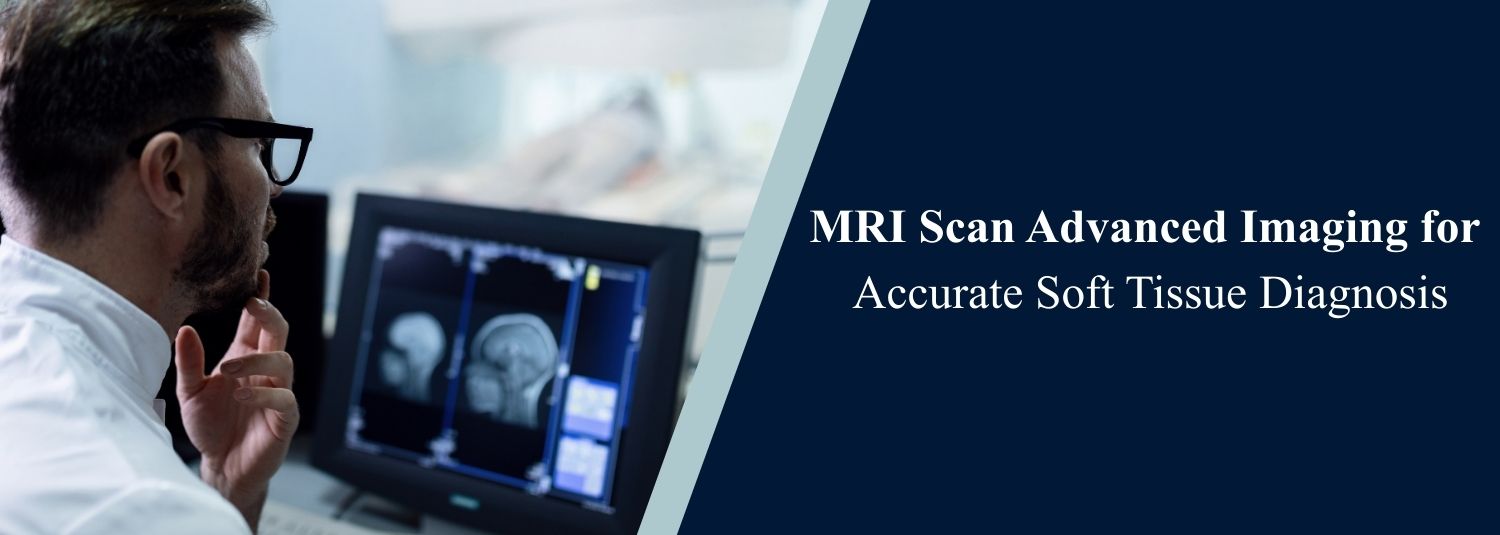
MRI Scan: A Complete Guide to Magnetic Resonance Imaging
Medical imaging plays a vital role in modern healthcare. It allows physicians to locate, diagnose, and monitor many medical conditions. One of the most advanced imaging techniques used today is MRI (Magnetic Resonance Imaging). MRI creates highly detailed images of soft tissues, organs, and other internal body structures.
Unlike many other imaging procedures, MRI scans do not use harmful radiation. Instead, they use strong magnetic fields and radio waves to produce clear images of the body. Because of this, MRI is considered a safe and non-invasive diagnostic tool. It is widely used to detect problems in the brain, spine, joints, muscles, and internal organs.
MRI is extremely valuable because it can detect abnormalities with high accuracy, even when other tests fail to identify the issue.
What Is an MRI Scan?
An MRI scan is a non-invasive imaging test that provides detailed pictures of organs and tissues inside the body. The MRI machine uses a powerful magnetic field and radio waves to generate these images.
During the scan, the patient lies on a table that moves into a large circular scanner. The machine captures detailed cross-sectional images of the body, allowing doctors to examine internal structures layer by layer.
MRI is particularly useful for imaging soft tissues that are difficult to see using X-rays or CT scans. Its high-resolution imaging helps detect early signs of disease and subtle abnormalities.
How Does an MRI Scan Work?
MRI technology works by aligning hydrogen atoms in the body using strong magnetic fields. When radio waves are applied, these atoms produce signals as they return to their original position. The MRI machine captures these signals and advanced computer systems convert them into detailed images.
These images show organs, muscles, ligaments, nerves, and blood vessels in great detail. Doctors can examine these structures from multiple angles to diagnose complex medical conditions accurately.
An MRI scan usually takes between 20 and 45 minutes depending on the part of the body being examined.
Common Uses of MRI Scans
MRI scans are widely used to diagnose a variety of medical conditions due to their ability to clearly visualize soft tissues. Doctors often recommend MRI for examining the brain, spinal cord, joints, and internal organs.
Brain and Nervous System Imaging
MRI is one of the most reliable techniques for diagnosing brain disorders. It can detect brain tumors, strokes, multiple sclerosis, and structural abnormalities in the brain.
Doctors may also recommend MRI for patients experiencing long-term headaches, seizures, memory issues, or nerve-related symptoms.
Spine and Musculoskeletal Imaging
MRI is frequently used to evaluate the spine, joints, muscles, and ligaments. It helps detect slipped discs, spinal cord injuries, ligament tears, and joint disorders.
This imaging technique is especially useful for diagnosing sports injuries and chronic back pain.
Organ and Soft Tissue Evaluation
MRI scans can examine organs such as the liver, kidneys, pancreas, uterus, and prostate. They are helpful in detecting tumors, cysts, inflammation, and structural abnormalities.
MRI is also commonly used in cancer diagnosis and treatment monitoring because of its highly detailed soft-tissue imaging.
Types of MRI Scans
| Type of MRI Scan | Purpose |
|---|---|
| Brain MRI | Evaluates brain tumors, stroke, and neurological disorders |
| Spine MRI | Detects disc problems, nerve compression, and spinal injuries |
| Joint MRI | Examines ligaments, cartilage, and joint structures |
| Abdominal MRI | Assesses organs such as liver, pancreas, and kidneys |
| Cardiac MRI | Evaluates heart structure and function |
| Pelvic MRI | Examines reproductive organs and pelvic structures |
Advantages of MRI Imaging
MRI scans offer several advantages compared to other imaging techniques, especially when examining soft tissues.
One of the biggest advantages is that MRI does not use radiation, making it safer for repeated imaging. It also produces extremely detailed images that help doctors detect small abnormalities.
MRI can capture images from multiple angles, allowing doctors to study complex body structures with greater precision. This improves diagnostic accuracy and helps in planning effective treatments.
Another important benefit is that MRI can detect diseases at an early stage, which allows timely treatment and better health outcomes.
Preparation for an MRI Scan
MRI scans usually require minimal preparation. However, patients are typically asked to remove metal objects such as jewelry, watches, and electronic devices before entering the MRI room.
In some cases, a contrast dye may be used to highlight certain tissues or blood vessels. Patients should inform their doctor if they have allergies, kidney problems, or medical implants such as pacemakers.
Patients are usually advised to wear comfortable clothing and may be asked to change into a hospital gown before the scan.
Frequently Asked Questions
In News
Get Our Mobile App
for Easy Access
Book tests, view reports, and manage your health records on the go. Experience convenient healthcare with Molecular Diagnostics and Therapy.
- ✔ Book tests & home collection
- ✔ View reports instantly
- ✔ Track health history
- ✔ Get notifications & reminders
- ✔ Easy appointment management